
Plan a weekend with friends that actually happens
A weekend away almost never dies over the budget or the destination. It dies at step one: finding three consecutive days everyone is free. That's where the tool belongs, and nowhere else.
- 1
Open a window, not a date — "a weekend before autumn": with six people, a date proposed up front rules out half the group before the conversation even starts.
- 2
Cross-reference the calendars — guests with the app connect their calendar; the "Best slot" view colours each day by how many people are free, across three months.
- 3
Settle the date, then the destination — the other way round costs three weeks: you pick a place, find out nobody can make it, and start again.
- 4
Split the jobs before booking — a poll in the outing settles the destination and the accommodation; every job has a name against it.
The rest — the accommodation, the food, the money — happens with the tools your group already uses. To Gather isn't trying to replace them: it handles the part where everyone gives up.
Why nine weekends out of ten never happen
Three causes, always the same, and none of them is a lack of enthusiasm.
The combinatorics
Six people × three consecutive days × twelve candidate weekends: that's 216 combinations to check. A message thread can't hold that calculation, and a poll grid becomes unreadable long before.
Answers that go stale
Someone says "I'm free every weekend in May", then books something on the 17th. Their answer stays in the thread, wrong, and nobody knows until the booking.
The lone organiser
One person chases, copies, compares, books. Eventually they give up — and the weekend dies with their energy, not with the group's enthusiasm.
Finding three consecutive days everyone is free
This is the only step that genuinely needs a tool. In To Gather, each participant with the app connects their calendar once: busy slots surface on their own and the "Best slot" view colours each day by how many people are free — green everyone, orange some, red nobody. Two or three green days in a row is your weekend.
Those without the app tick their days straight from the outing's link, with no account. Both sources feed the same view, so the group never has two versions of the truth.
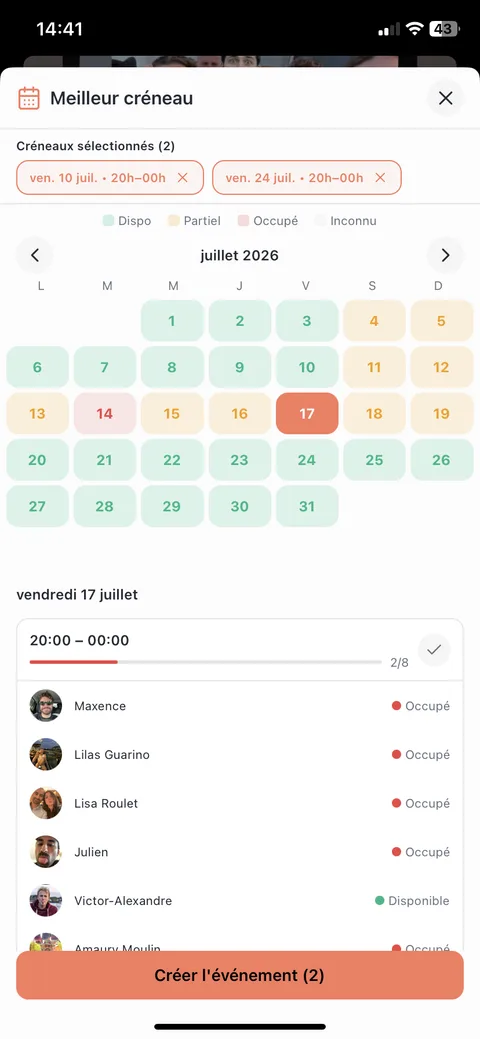
Nobody reads anybody's calendar: your friends see "busy", never the title, place or attendees of an appointment. You can switch the sharing off whenever you like.
One limit to know: availability only syncs over the next three months. For a weekend six months out, settle the month first, then reopen the view once it enters the window.
Timeline: from D-90 to coming home
Calibrated for six to eight people and a domestic trip. For abroad or a long weekend, move everything a month earlier.
| When | What the group does | What breaks if you skip it |
|---|---|---|
| D-90 | Open the outing with no date, invite everyone, announce the window you're aiming at. | Everyone keeps a different idea of what "this autumn" means. |
| D-60 | The calendars cross-reference. You settle the date, for good. | With no firm date, nobody commits to anything else. |
| D-55 | Poll on the destination and the accommodation — two questions, not ten. | An open debate about where to go never closes by itself. |
| D-45 | Book. One name against each job: the roof, the travel, the food. | The good options go, and the lone organiser starts carrying it alone. |
| D-7 | Confirm the time and the meeting point, in the outing's thread. | Logistics questions scatter across four different chats. |
| The weekend | Nothing. The photo prompt goes out during the trip. | Nobody thinks to take a group photo. |
| D+1 | The album opens for everyone who was there. | The photos stay in four camera rolls and never come out. |
Split it up, or one person carries everything
Four jobs, four names. It's the only thing that stops a weekend resting on one person's energy.
The date
Whoever opens the outing, chases the quiet ones and makes the call. This job ends the day the date is settled — it must not quietly become the job of everything else.
The roof
Compares two or three options, not fifteen, and puts a closed-choice poll in the outing. A poll takes up to ten options; in practice three is plenty.
The travel
Who's driving, who's on the train, who picks up whom. It's the most forgotten job and the one that generates the most messages the night before.
The supplies
Food, meals, kit. The only job where the group genuinely needs a shared list — the one you already keep somewhere.
What To Gather does, and what it doesn't
Best said up front: the app covers the beginning and the end of the weekend, not the middle.
To Gather handles it
- Cross-referencing calendars and surfacing the days everyone is free
- Inviting by link, with nothing to install in order to reply
- Tracking who's in, who's unsure and who's out — always up to date
- Settling a closed question (destination, accommodation) with a poll
- Reminding everyone who has the app as the date approaches, without you chasing
- Triggering the photos during the weekend and opening the album afterwards
Keep your usual tool
- Splitting expenses and settling up at the end
- The shared money pot
- Booking accommodation or transport
- The shopping list and the meals
- Contacts and things to do once you're there
A tool that claims to do everything rarely ends well: what was missing was the "deciding together" part, and that's the part we handle.
The weekend doesn't end when you get home
During the trip, a photo prompt goes out to the participants: everyone captures their moment, and nothing appears. The album opens all at once at 6pm once the weekend is over, only for the people who were there. It's the one thing still around three months later, and the one nobody thinks to organise.
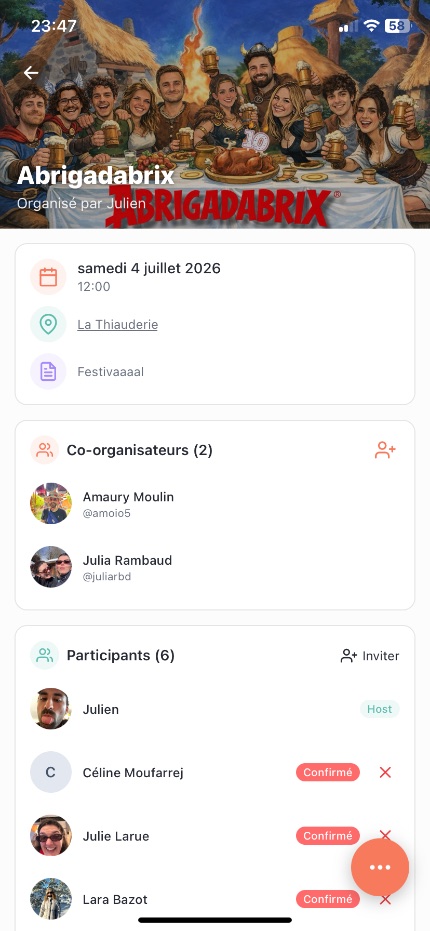
The guest book, which you switch on for the outing, works the same way: everyone leaves a note during the trip, it only opens when the photos are revealed, and only the host and their co-hosts read it.
Weekend with friends: frequently asked questions
How do you plan a weekend with friends when nobody has the same free days?
Stop asking "who's free?" and let the calendars cross-reference each other. With six people across twelve candidate weekends there are more than two hundred combinations to check: that's machine work, not message-thread work. In To Gather everyone connects their calendar once and the "Best slot" view surfaces the consecutive days when the most people are free. If no perfect slot exists, the same view shows which one costs the fewest people — and making that call, openly, is what gets the weekend off the ground.
How far in advance should we start?
Two to three months for six to eight people close to home, four to five for abroad or a long weekend. The limiting factor isn't the booking, it's how long the group takes to answer: allow two weeks between opening the outing and settling the date, then book straight away. A settled date left three weeks without a booking becomes negotiable again.
How do we choose the destination without spending three weeks on it?
By closing the question. An open discussion about "where shall we go?" never closes by itself: someone proposes two or three concrete options — with the price and the travel time — and puts a closed-choice poll in the outing. A To Gather poll takes up to ten options; past three, you've just moved the argument. And above all: the destination is chosen after the date, never before.
Does To Gather handle the budget and expense splitting?
No. There's no money pot and no end-of-trip settling up in the app, and none is planned. To Gather covers the date, the invitations, the reminders and the photos; for expenses, keep whatever the group already uses. What we can do for you is not pretend otherwise.
Does everyone have to install the app?
No. The outing's link is enough to reply, change your mind, tick the days that work and send photos during the weekend — from a browser, with no account. The app adds calendar syncing, automatic reminders, the group chat and the album you can browse afterwards. In practice: the people making the decisions install it, the others reply by link.
Does it work for a weekend abroad, with a time difference?
Yes. Every outing stores the time zone of the place and always shows the local time at the destination, never a conversion into your phone's zone. If your device is in another zone, the time stays the venue's and the app says so. That's what avoids the classic "meet at 9" understood two different ways.
Can we set up a weekend that repeats every year?
Yes. An outing can be created as a recurring series, and each occurrence keeps its own replies and its own photos. The guest list and the format carry over; availability is recalculated every time — which is rather the point.
What's the maximum group size?
A regular outing sets no maximum number of guests. The real ceiling is human: past about ten people, a weekend can no longer be decided unanimously. Beyond that, settle the date around the subgroup that absolutely has to be there, then open the invitation to everyone else — it's the only approach that gets there.
The weekend you've been talking about for six months.
Install the app, open the outing with no date, send the link to the group. The window everyone shares will surface on its own.
Free · no ads · iOS & Android
Read next
Finding a common date with friends
Read next
Inviting friends without making them install the app
Read next